Start with a complete lot record
Create a lot ID when you buy a box, collection, or mixed batch. Record the purchase date, seller or source, amount paid, directly related acquisition costs, and storage location. Keep your receipt or invoice. The goal is to answer where an item came from and how much of the purchase cost it carries.
Keep an item ID or SKU tied to the lot ID as you photograph, list, move, and sell the item. If the title changes, the link to the purchase should survive. For a physical collection, record a bin or shelf location too, so a sold item can be found without reversing the whole listing process.
Pick an allocation method you can apply consistently
Equal per-unit allocation is the simplest: divide the allocable lot cost by the number of units. It works best when the items have roughly similar value. For a mixed lot with a few expensive pieces and many low-value ones, an estimated-value or manual allocation may better reflect the economics. Record the method and avoid changing it silently after sales begin.
Example: equal allocation
A lot costs $120 and contains 20 resalable items. Equal allocation assigns $6 cost to each item. If one sells for $22 and its selling fees, shipping, and supplies total $7, its estimated sale profit is $22 − $7 − $6 = $9. The lot still has $114 of assigned item cost across its remaining 19 units.
If one item is worth most of the lot, use a different allocation method and document why. The $6 average would distort that item's profit.
Follow the cost through the sale
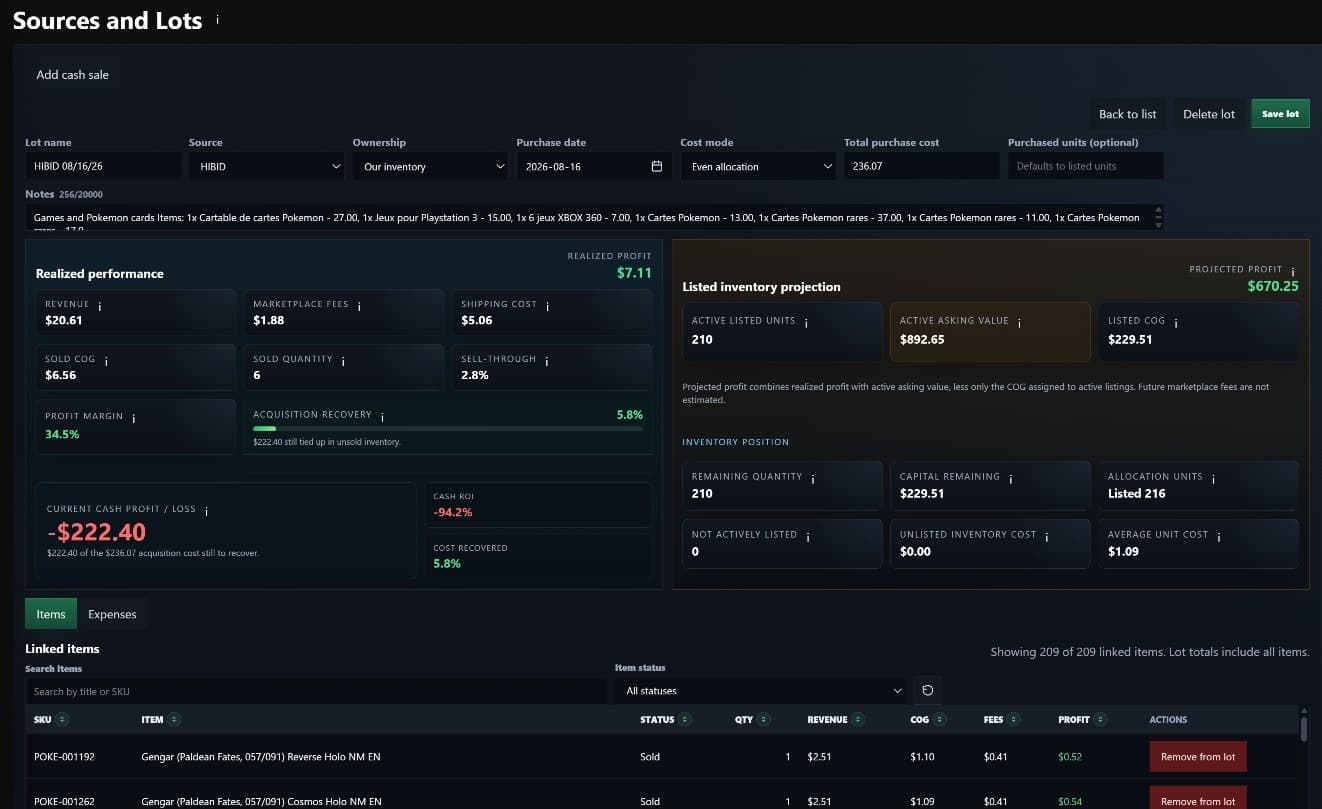
- Assign each item its SKU, lot, quantity, and cost share when inventory is prepared.
- Keep that identity attached to the live listing and any imported marketplace sale.
- When an item sells, use its allocated cost with the actual fees and shipping to calculate sale profit.
- Review remaining stock and accumulated sold profit at the lot level before deciding whether the purchase has paid back.
For the sales calculation, see how to calculate eBay profit after fees and shipping. For the upstream listing workflow, see how to list a large card collection.
Keep estimates distinct from recorded costs
Expected resale value is useful for deciding how to allocate a mixed lot, but it is not the same as the purchase cost. Save the original lot amount and the allocation you used. If additional freight, a partial return, or a correction changes the total, record the adjustment so past and future profit reports can be interpreted.
Lots of Lots provides source and lot views, cost allocation, inventory links, and sales/profit reporting. Review the feature overview for the current workflow. Your bookkeeper or tax professional can advise which cost treatment fits your business and jurisdiction.
Common questions
Can I count an item from a paid lot as having zero cost?
That would overstate its sale profit. Allocate the purchase cost across the lot using a documented method, even if a particular item was a surprise find.
What if some items never sell?
Keep them linked to the lot as remaining inventory or record their later disposition. Do not quietly transfer their cost to sold items without a consistent, documented reason.